
They tell you to increase velocity. So, you optimize.
You drop the unit tests.
You timebox QA to 15 minutes.
Your acceptance criteria becomes “it compiles on my machine”.
Your release gate is basically just vibes.
You ship the feature, close the Jira ticket, and successfully transition your software company into a highly profitable customer support business.
If your goal is to leave an unforgettable trace, this is brilliant. Nothing leaves a bigger legacy than a production being down at 10 a.m. on Monday.
Let’s talk facts, not feelings.
“Production Is Free Testing”
Yes, production is the most real staging environment you have. It’s also the only one that comes with:
Real customers
Real money
Real reputational damage
Real 2 a.m. wake up calls on incidents
Calling it “free testing” is like calling a car crash “rapid prototyping.” Reality charges interest. You can pay early with automated tests, or you can pay late with incidents, rollbacks, and meetings where managers ask “how did this happen?”
The Data Doesn’t Care About Your Velocity
High-performing teams don’t go faster by skipping tests; they go faster by reducing rework.
DORA research and the Accelerate framework keep repeating the same boring, undefeated mechanism: short feedback loops correlate with better lead time and stability.
Fast feedback beats heroic debugging.
Test earlier, discover less garbage later.
Why Engineers “Hate” Testing?
We don’t hate testing. We hate testing theater.
“It slows us down.” It slows you down today so you don’t lose three days next week fixing a bug while the whole company breathes down your neck. Rework is the real tax.
Coverage worship. 90% test coverage is a metric invented for PowerPoint presentations. 90% coverage means nothing if you never test the scary paths. Confidence > coverage.
Code-hugging tests. If a rename nukes your suite, you’re checking wiring, not outcomes. Test the result customers and systems experience.
UAT as a seatbelt. User Acceptance Testing is a last look, not a safety net. If UAT is catching basic logical errors, you’re outsourcing engineering to the business side. Spoiler: the business doesn’t want that job.
What Testing Is Actually For?
You don’t write tests to please a manager or to satisfy a quality gate. You write them to answer one selfish question:
“How do I know this works without manually clicking through the app for 20 minutes every time I change a variable?”
Tests are your receipts.
Receipts that yesterday’s code still works today. Receipts that you can hit Deploy on a Friday afternoon and go to the pub without praying. That’s not bureaucracy. That’s armor for your comfort zone.
The Real Cost of “We’ll Test Later”
Late defects compound. If catching a bug costs 5 minutes locally, it costs 5 hours in staging, 5 days in production, and 5 weeks of trust-rebuilding if it affects users. Tests aren’t overhead—they’re insurance with a massive ROI.
The Playbook for Pragmatic Testing
Good teams don’t bolt testing on at the end. They bake it in to protect their peace.
Behavior over Surveillance
“Given X input, expect Y output.” You want confidence, not a security camera pointed at your internal methods.The Pyramid, Not the Snow Cone
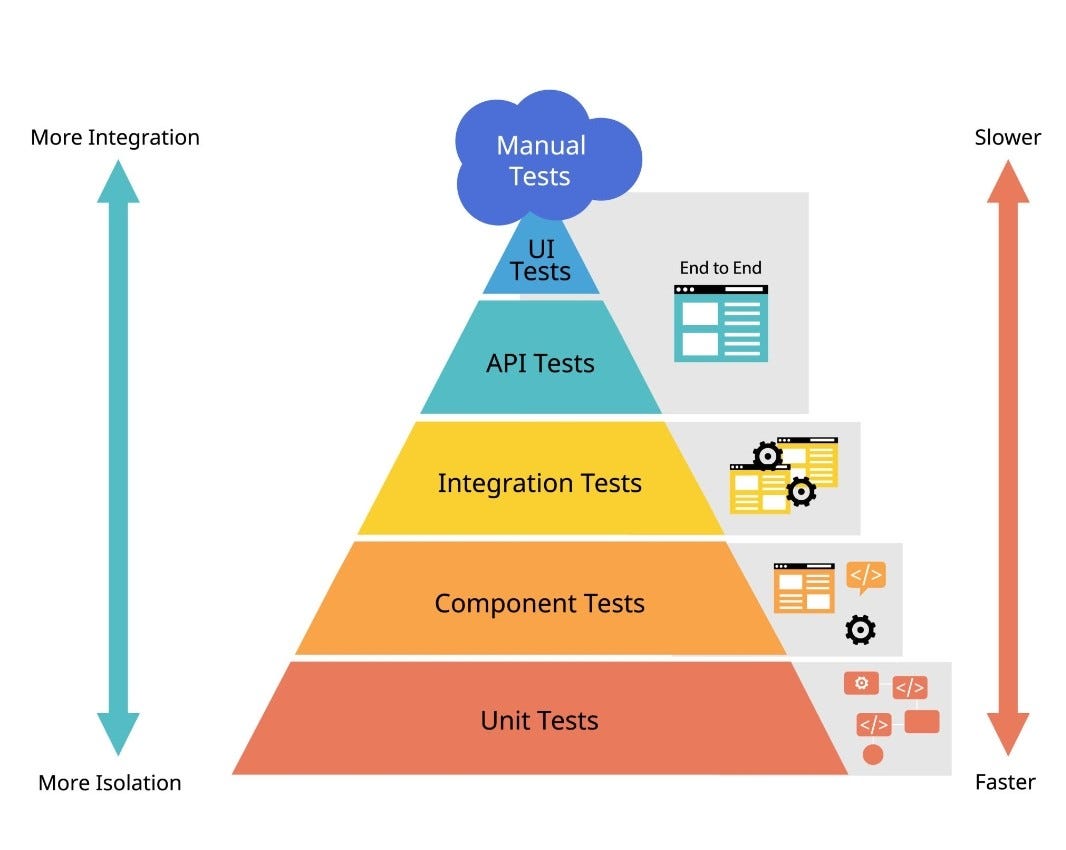
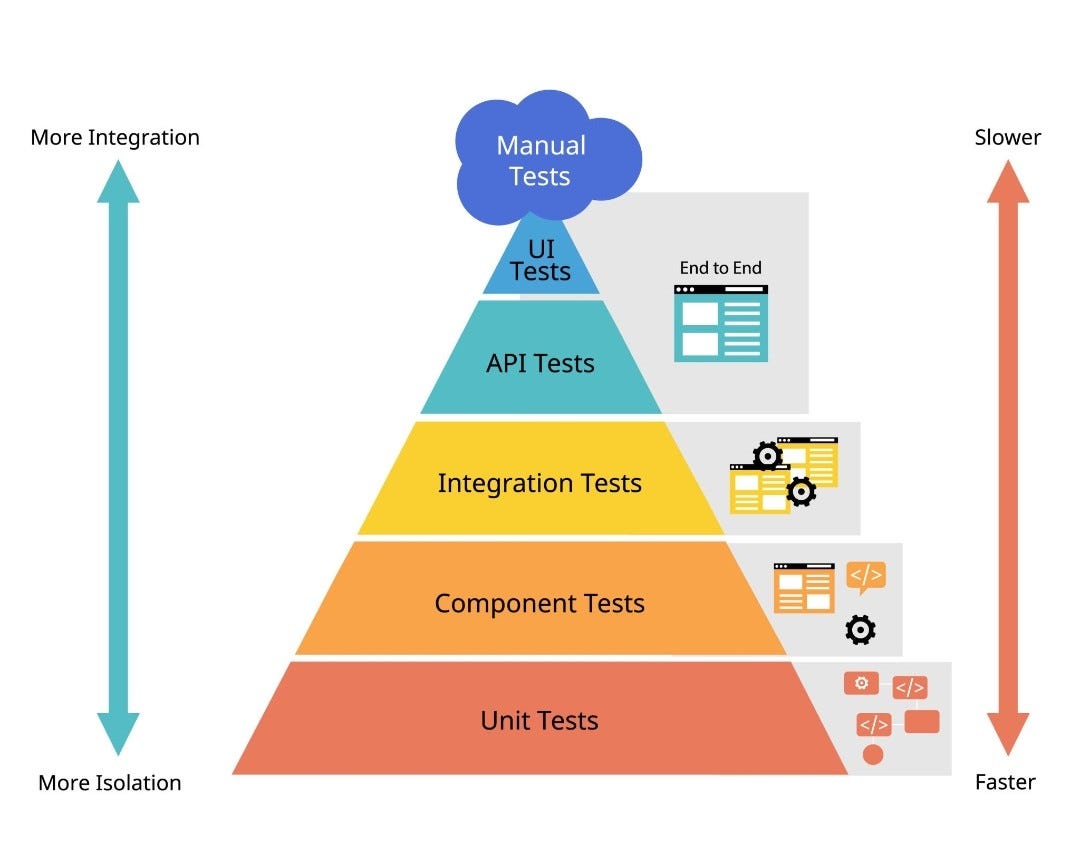
Keep feedback fast and cheap. Write many deterministic Unit tests. Have fewer boundary-focused Integration tests. Keep E2E (End-to-End) tests strictly for the money-paths. Snow cones (all E2E tests) melt during CI and block the pipeline.
Speed Is a Feature
If the test suite takes 45 minutes to run, you’ll start “temporarily” skipping it. Temporary becomes a lifestyle. Keep it in single-digit minutes.The Tripwire Protocol
When a bug appears in production, don’t just fix it. First, write the automated test that would have caught it. Then fix the code. Now that specific class of bug has a permanent motion sensor.
The Ultimate Proof
If you are “moving too fast to test,” you aren’t moving fast. You are gambling. And gambling scales terribly.
Here is the data to throw at management when they ask you to skip testing for velocity:
DORA / Accelerate: Teams with CI, automated testing, and small changes show better lead time and stability. (https://dora.dev/)
NIST Study: Inadequate testing infrastructure drives huge economic waste, mostly from defects escaping to production. (https://www.nist.gov/system/files/documents/director/planning/report02-3.pdf)
If your career goal is to curate outages, write post-mortems, and call screenshots “proof,” then by all means—skip the tests. Ship vibes.
Otherwise:
Write tests as proof.
Protect your time.
Ship like you meant it.
Be an engineer.
Subscribe. More exhibits coming soon.
👌